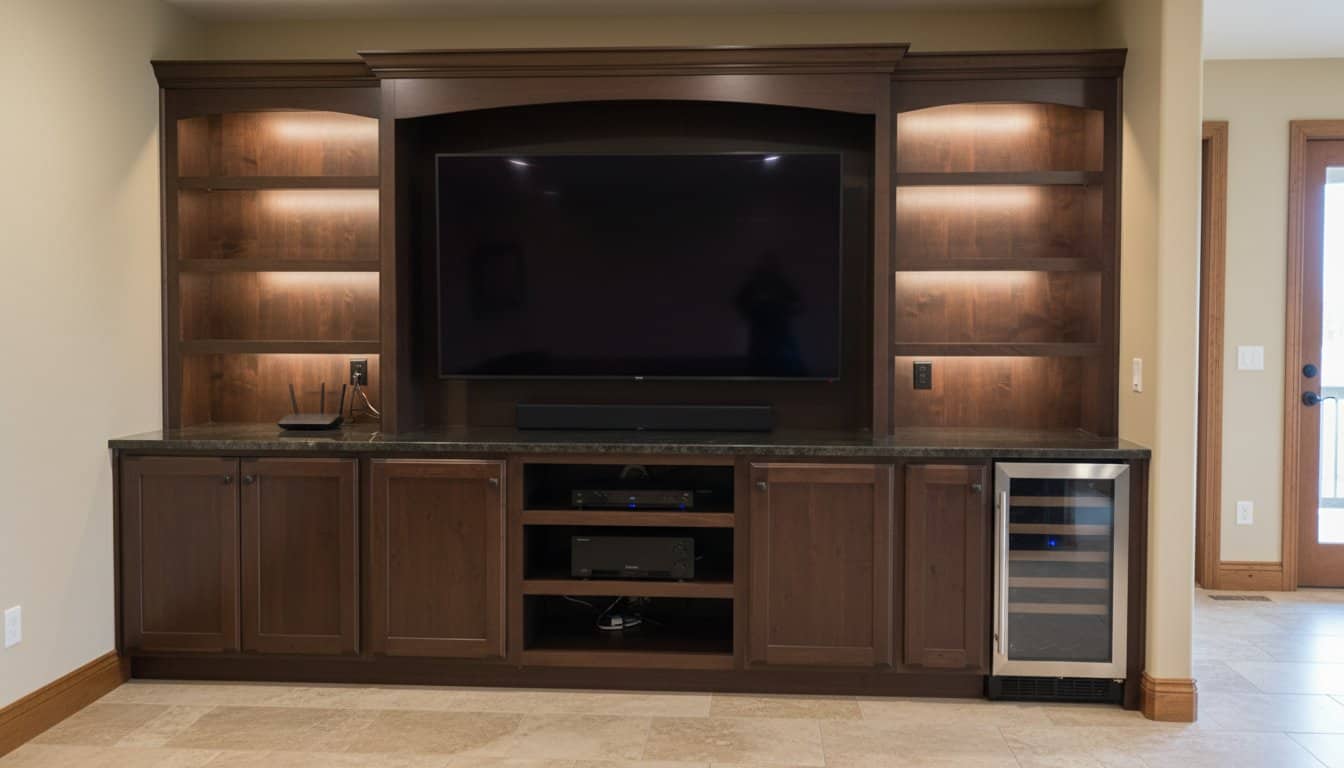
An integrated media center brings televisions, speakers, gaming systems, streaming devices, storage, and display space together in one organized entertainment setup. Rather than designing the room around separate pieces of furniture and visible electronics, a custom media center creates a unified solution built around the space and the equipment you actually use.
For homeowners who want entertainment technology without sacrificing interior design, custom media centers can provide concealed storage, organized wiring, equipment ventilation, display shelving, and cabinetry that complements the surrounding room.
Key Takeaways
- An integrated media center combines entertainment equipment, storage, displays, and cabinetry into one coordinated design.
- Custom construction can accommodate the dimensions of your television, speakers, consoles, and other electronics.
- Cable management and equipment ventilation should be planned before the cabinetry is built.
- Open shelving works well for decorative items, while closed cabinetry can conceal electronics and accessories.
- A custom entertainment center can be designed for living rooms, man caves, gaming rooms, basements, and other entertainment spaces.
- Planning for future equipment upgrades can make the media center more adaptable over time.
Integrated Media Center vs. Standard TV Stand
Both options can support entertainment equipment, but they solve different design problems.
| Integrated Media Center | Standard TV Stand |
| Designed for a specific room | Manufactured in standard sizes |
| Can accommodate specific equipment | Limited by existing openings and shelves |
| Offers built-in cable management options | Cables may remain visible |
| Can combine open and closed storage | Usually provides limited storage |
| Can extend across an entire wall | Occupies a smaller defined area |
| Materials and finishes can match the room | Limited to available retail finishes |
| Can incorporate future expansion | Less adaptable to major equipment changes |
A standalone TV stand may be sufficient for a simple setup. A custom media center becomes more valuable when homeowners need substantial storage, integrated electronics, display space, or a more permanent architectural feature.
Why Choose a Custom Media Center?
The primary advantage of a custom media center is that the design begins with your room rather than forcing your room to accommodate a prebuilt piece of furniture.
Wall dimensions, television size, electrical access, speakers, gaming equipment, storage requirements, and interior style can all influence the final layout.
This flexibility can be especially useful in rooms with unusual dimensions, large televisions, extensive entertainment systems, or specific storage needs.
Create a Cleaner Entertainment Setup
Entertainment spaces can accumulate a surprising number of devices and accessories.
A television may be surrounded by receivers, streaming devices, game consoles, controllers, remotes, routers, speakers, headphones, cables, movies, and decorative objects.
Without dedicated storage, these components can make even a well-designed room feel cluttered.
An integrated media center can provide specific locations for each item so frequently used equipment remains accessible while less attractive accessories stay concealed.
Incorporate Audio Equipment Into the Design
Audio systems also need to be considered early.
Soundbars, receivers, subwoofers, speakers, and other components may require specific placement for both performance and accessibility.
Cabinet doors, shelves, and decorative elements should not unintentionally obstruct equipment that needs to remain exposed.
For more sophisticated audio systems, the media center should also be coordinated with the overall room layout so speaker placement works with the primary seating positions.
Combine Open Shelving and Closed Storage
Not everything in a media center needs to be hidden.
Open shelving is ideal for items intended to become part of the room’s design, while closed storage can conceal equipment and accessories.
Open Shelving Can Display
Books, collectibles, artwork, photographs, sports memorabilia, gaming collectibles, decorative objects, and other personal items.
Closed Cabinetry Can Store
Controllers, remotes, cables, movies, games, headphones, electronic accessories, manuals, and other items that do not need to remain visible.
Combining the two provides both practical storage and opportunities for personalization.
Explore additional possibilities with custom shelving and cabinets.
Use Custom Cabinetry to Match the Room
An integrated media center does not need to look like a separate piece of entertainment furniture.
Cabinet proportions, materials, finishes, hardware, and shelving can be selected to coordinate with the surrounding architecture and interior design.
A traditional room may benefit from detailed cabinetry and warmer finishes, while a contemporary entertainment space may use simpler lines and concealed storage.
For homeowners looking for a fully tailored solution, custom cabinetry can help transform the entertainment wall into a more permanent part of the room.
Integrated Media Center Ideas for Different Rooms
Media centers are not limited to traditional living rooms.
Different spaces require different priorities.
| Room | Media Center Priorities |
| Living room | Balanced design, concealed electronics, decorative shelving |
| Man cave | Large screen, audio equipment, memorabilia storage |
| Gaming room | Console storage, controller organization, ventilation |
| Basement | Large entertainment wall, storage, flexible seating |
| Family room | Accessible storage, multipurpose entertainment |
| Sports room | Multiple screens, equipment storage, display shelving |
| Home theater | Screen integration, audio components, minimal distractions |
Understanding how the room will actually be used helps determine the right combination of cabinetry, technology, and storage.
Design a Media Center for Gaming
Gaming setups often require more equipment than standard television viewing.
Multiple consoles, controllers, charging stations, headsets, games, computers, and accessories all need dedicated storage.
Ventilation and cable management become particularly important when several electronic devices are grouped together.
Custom storage can also make frequently used equipment more accessible while keeping controllers and accessories organized between gaming sessions.
For more ideas, explore custom gaming essentials for creating a more organized gaming environment.
Consider Lighting as Part of the Media Wall
Lighting can make a media center more functional while highlighting architectural details and displays.
Possible options include shelf lighting, under-cabinet lighting, accent lighting, or nearby dimmable room lighting.
The important consideration is screen visibility.
Poorly positioned fixtures can create reflections or glare, so lighting should support the entertainment experience rather than interfere with it.
Display lighting can also draw attention to artwork, collectibles, or memorabilia without requiring the entire room to remain brightly illuminated.
Create a Media Center Around a Fireplace
Televisions and fireplaces are often located on the same feature wall, creating an additional design challenge.
The cabinetry needs to account for the dimensions and location of both features while maintaining comfortable television viewing.
Rather than automatically positioning the television above the fireplace, consider the room’s seating arrangement, screen height, and overall proportions.
Custom cabinetry can sometimes provide alternative television locations while maintaining visual balance across the wall.
Plan for Gaming Consoles and Streaming Devices
Entertainment technology changes frequently.
A media center designed only around today’s devices can become inconvenient when equipment is replaced.
Consider leaving adaptable compartments for consoles, streaming devices, receivers, or future electronics.
Removable shelves and accessible cable pathways can make equipment changes easier without requiring major cabinet modifications.
Think About Future Television Upgrades
Television sizes continue to change, and homeowners often upgrade displays before replacing cabinetry.
If the media center surrounds the television on all sides, avoid creating an opening that can accommodate only the exact dimensions of the current screen.
Leaving some flexibility around the primary display can extend the useful life of the cabinetry.
This consideration is particularly important when investing in a permanent built-in system.
Frequently Asked Questions About Integrated Media Centers
What can be included in a custom media center?
A custom media center can include television space, shelving, cabinets, drawers, speaker locations, gaming console storage, audio equipment compartments, decorative displays, cable routing, and other features based on the homeowner’s needs.
Can my existing TV and entertainment equipment be incorporated?
Yes. A custom design can be planned around existing televisions, consoles, speakers, receivers, and other equipment. Providing equipment dimensions during the design stage can help ensure appropriate fit and accessibility.
How do you hide wires in a custom media center?
Cable pathways can be incorporated into the cabinetry so wires can pass between the television, electronics, speakers, outlets, and other equipment. The exact approach depends on the room and media center design.
Do entertainment center cabinets need ventilation?
Compartments containing heat-producing electronics may require airflow. Ventilation requirements depend on the equipment, cabinet configuration, and how enclosed each component is.
Should a media center be built around the exact size of my TV?
Usually, some flexibility is useful. Building an opening around the exact television dimensions may make future screen upgrades difficult, so potential replacement sizes should be considered during planning.
Can an integrated media center include a gaming setup?
Yes. Consoles, controllers, charging accessories, headsets, games, and related equipment can all be incorporated into a custom entertainment center.
Can a media center include both open shelves and cabinets?
Yes. Combining open shelving with closed cabinetry allows decorative items to remain visible while electronics, accessories, and other clutter can be concealed.
How long does a custom media center take to complete?
Project timelines depend on design complexity, materials, fabrication requirements, installation conditions, and current scheduling. Man Caves and More can provide a more accurate timeline after reviewing the specific project.
Create an Integrated Media Center Designed Around Your Space
A successful integrated media center does more than surround a television with cabinetry.
It considers how the television, audio system, gaming equipment, cables, ventilation, storage, displays, lighting, and future technology will work together.
Man Caves and More can create a custom media solution tailored to your room, equipment, storage needs, and design preferences.
Get a Free Quote and start planning an entertainment center that combines organized technology with custom craftsmanship.